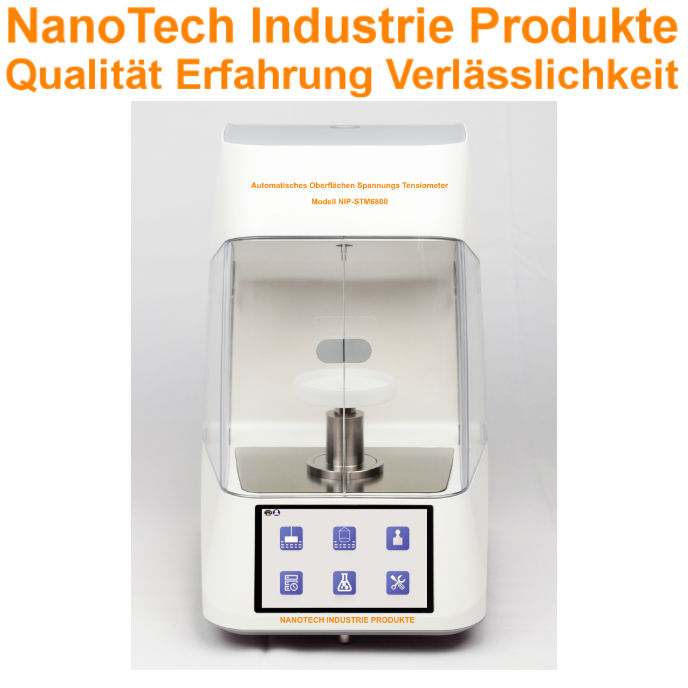
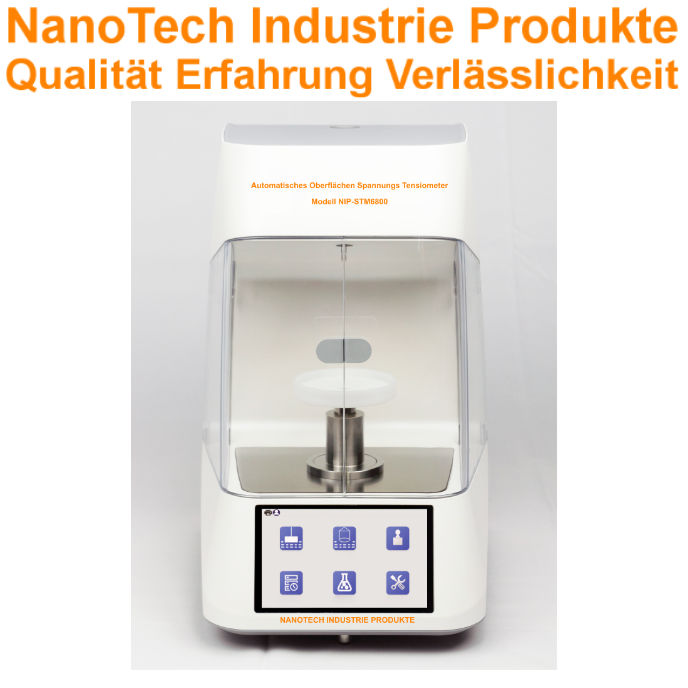
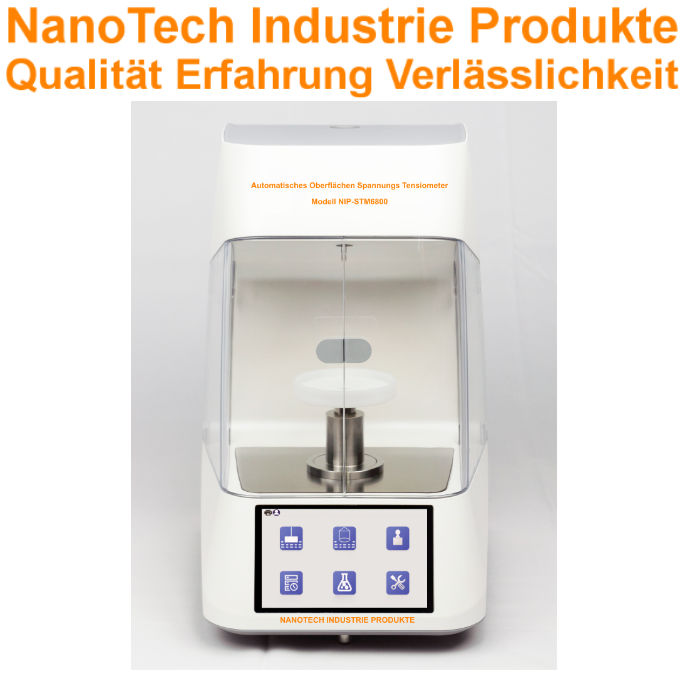
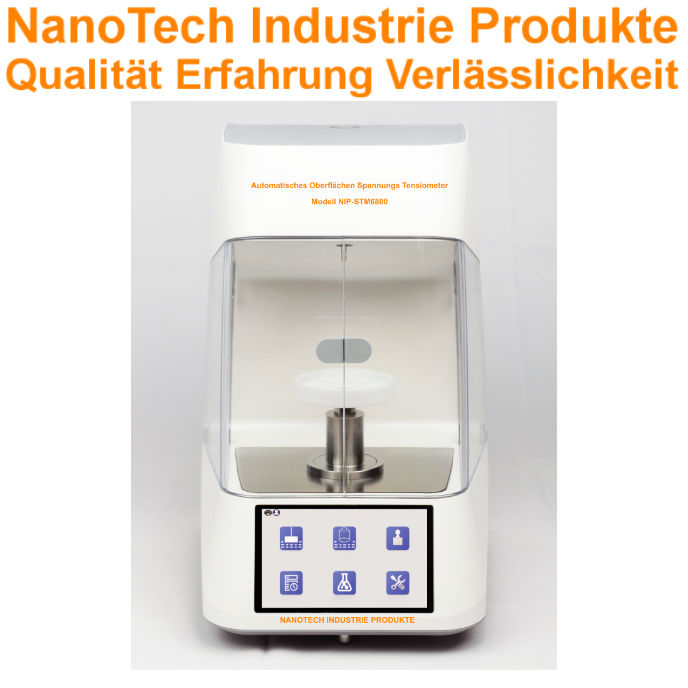
Automatic surface tension meter - Applications:
The Surface tension The viscosity of a liquid is a key physical quantity that characterizes the behavior of liquids at interfaces. The precise determination of this quantity is important in numerous scientific and industrial applications.
This Automatic surface tension meter, also Tensiometer This method allows the quantitative determination of surface tension based on various physical principles. Common test methods are described in detail below.
1. Wilhelmy plate method:
This method is based on measuring the force acting on a thin, precision-machined plate immersed vertically in the liquid. The precision-machined plate is positioned so that its lower edge touches the liquid surface. The force (F) acting on the plate is composed of the plate's weight (F_g) and the force due to surface tension (F_{gamma}).
The force (F_{gamma}) is proportional to the surface tension ( gamma ) and the wetted circumference of the plate (P):
[ F_{gamma} = gamma cdot P cdot cos(theta) ]
where ( theta ) is the contact angle between the liquid and the plate. For a completely wetting plate (idealized, ( theta = 0^circ ), ( cos(theta) = 1 )), the equation simplifies to:
[ F_{gamma} = gamma × P ]
The surface tension meter measures the total force (F), and taking into account the weight of the plate, the surface tension can be calculated:
[ gamma = frac{F - F_g}{P} ]
Test execution:
- The Wilhelmy plate is carefully cleaned to avoid contamination that could affect the contact angle.
- The surface tension meter is calibrated.
- The liquid sample is placed in a suitable container and brought to a stable temperature.
- The plate is slowly lowered until it touches the liquid surface. The immersion process is precisely controlled to minimize vibration.
- The measuring device records the maximum force acting on the surface when the plate is immersed or in a static state.
- The surface tension is calculated using the measured force and the known wetted circumference of the plate.
- The measurement is usually repeated several times to ensure reproducibility.
2. Du-Noüy ring method:
This method measures the force required to move a thin precision-crafted platinum ring from the liquid surface. The maximum force (F) when tearing off the ring is proportional to the surface tension (gamma) and the circumference of the ring (L):
[ F = 2 pi R gamma cdot f ]
where (R) is the radius of the ring and (f) is a correction factor that depends on the geometry of the ring and the properties of the fluid (e.g., the ring thickness and the volume of the lifted fluid).
Test execution:
- The Du Noüy ring is carefully cleaned and freed from impurities.
- The surface tension meter is calibrated.
- The liquid sample is placed in a suitable container and tempered.
- The ring is immersed in the liquid and then slowly lifted again.
- The gauge records the maximum force required to detach the ring from the surface.
- The surface tension is calculated taking into account the ring radius and the correction factor. The correction factor can be determined using tables or numerical methods.
- The measurement is carried out several times to ensure statistical reliability.
Analysis of the measurement results:
Scientific analyses include statistical evaluation of repeated measurements, error estimation, and consideration of influencing factors such as temperature and impurities. The results can be used to characterize fluids, investigate interfacial phenomena, or for quality control in industrial processes.
This professional Automatic surface tensiometers is optionally available with a precision-machined Du Noüy ring and with a precision-machined Wilhelmy plate available. The Du-Noüy-Ring method is ideal as an all-round testing method and the Wilhelmy test method offers a slightly higher measurement accuracy in comparison.




















 Deutsch
  Français
 Español
 Svenska
 Nederlands (België)
 Dansk
Dansk
 Ελληνικά
 Suomi
Suomi
 Italiano
 English