



Product Description:
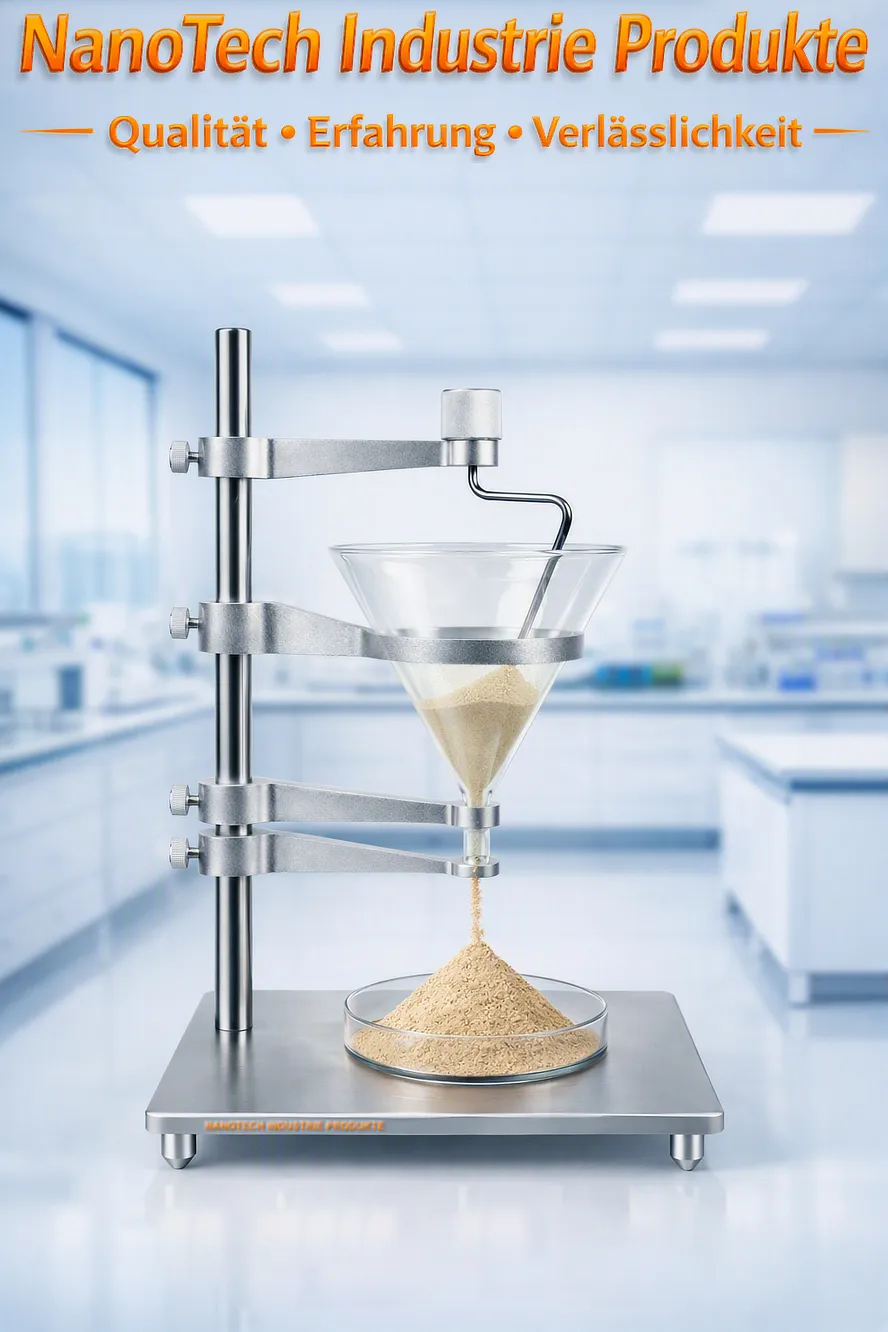
Nanotech Industrie Produkte Angle of Discharge Tester is a precise Slope angle test setup with a high-quality glass funnel to determine the angle of repose and angle of rest of powders and granules and powder-like samples.
The angle of repose is an important parameter for the flow behavior of bulk solids. Its determination is important in many industrial sectors to optimize processes and ensure product quality. By using this precision-engineered angle of repose test setup, the angle of repose can be measured quickly, effectively, and relatively easily.
The determination of angle of repose and angle of internal friction takes place by flowing a powder sample through the flow funnel. The powder sample flows through the flow funnel onto the powder sample platform and forms a cone of powder. The measurement of the diameter and the height of the cone of powder calculates the angle of repose. The angle of repose is a measure of the flow behavior of powder samples. A smaller angle of repose points to a better one flow behavior Add the powder sample.
This professional Repose angle apparatus with high-quality glass funnel to determine the angle of repose and slope angle of powders combines an ergonomic design with a sturdy, high-quality stainless steel construction, paired with a precision-machined with a high-quality glass trickle reactor with a 60° angle and an outlet opening diameter of 10.0 mm, a powder sample surface with a diameter of 100.0 mm, and a comprehensive set of accessories including a powder overflow collection tray and much more.
To ensure high precision, the precision-machined high-quality glassdropping funnel each from durable laboratory glassware manufactured.
This precision-machined Angle of repose apparatus with a high-quality glass funnel for measuring the flow behavior of powder samples is suitable for determining the flow behavior of a wide variety of powders and similar samples including metal powders, ceramic powders, pharmaceutical powders, cosmetic powders, powdered food raw materials including flour, sugar, flavor enhancers, milk powder, protein powder, cocoa powder, leavening agents, thickeners and many more.
This professional angle of repose testing setup with a high-quality glass funnel is manufactured in accordance with international technical guidelines, including:
- ISO 4324 (Surface active agents; Powders and granules; Determination of angle of repose)
- ISO 8398 (Solid fertilizers - Determination of static angle of repose (ISO 8398:1989, modified); German version EN 12047:1996)
- DIN 12047 (Solid fertilizers - Determination of static angle of repose (ISO 8398:1989, modified); German version EN 12047:1996)
- ASTM D6393-08 (Standard Test Method for Bulk Solids Characterization by Carr Indices)
- ASTM D6941-19 (Standard Test Method for Measuring Fluidization Segregation Tendencies of Powders)
- European Pharmacopoeia – EP 2.9.36/17
- US Pharmacopoeia – USP 1174
Repose angle measuring device with glass funnel – Applications:
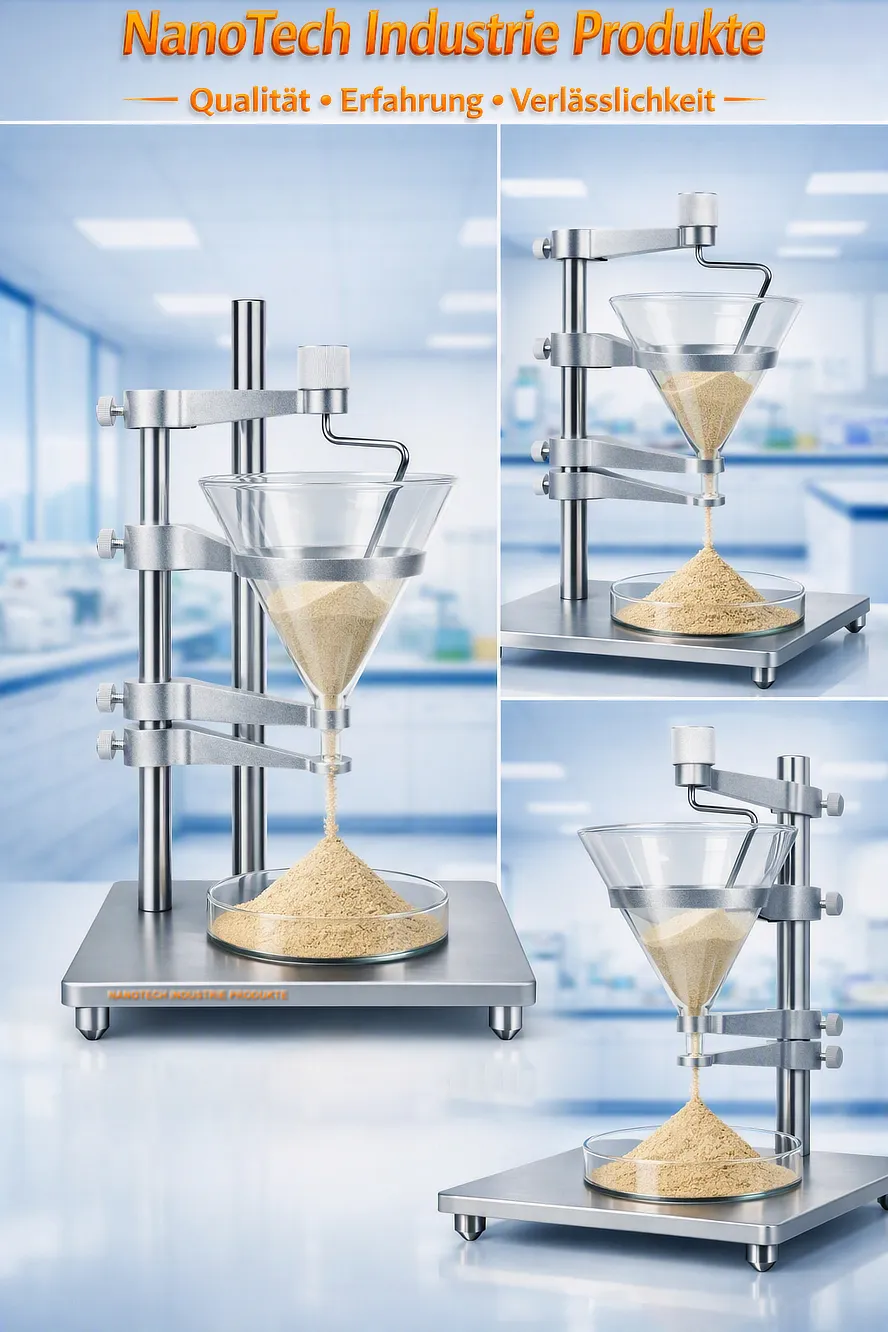
The Angle of repose tester with high-quality glass funnel is a precise slope angle gauge and precise powder flow test rig to determine the angle of repose of powders and granules and powder-like samples.
The determination of angle of repose takes place by flowing a powder sample through the flow funnel. The powder sample flows through the flow funnel onto the powder sample platform and forms a cone of powder. The measurement of the diameter and the height of the cone of powder calculates the angle of repose. The angle of repose is a measure of the flow behavior of powder samples. A smaller angle of repose points to a better one flow behavior Add the powder sample.
This precision-machined Angle of repose apparatus with durable laboratory glass funnel for measuring the flow behavior of powder samples is suitable for determining the flow behavior of a wide variety of powders and similar samples, including metallic powders, ceramic powders, pharmaceutical powders, and much more.
The angle of repose, too A Place of Peace ... is an important parameter in process engineering, particularly in the Powder and bulk solids technology. He describes the maximum angle at which a bulk material can be piled up on a flat surface without slipping.
A) Why is the angle of repose important?
i) Process optimization: Dosage: The angle of repose influences the dosing accuracy of bulk materials in containers or during conveying processes.
(ii) Storage: It provides information on the stability of bulk material piles and helps minimize the risk of slippage.
iii) Funding: The angle of repose is important for selecting appropriate conveying equipment (e.g., belts, screw conveyors).
iv) Product Development: Formulation, by measuring the angle of repose, formulations can be optimized to improve the flow behavior of products.
v) Quality Assurance: Consistency: The angle of repose serves as a quality parameter for assessing the consistency of products.
B) How does the angle of repose test setup work?
This professional Angle of Discharge Test Setup consists of:
i) Precision-crafted glass trickling funnel: A high-quality precision-engineered laboratory glass funnel through which the bulk material flows onto the high-quality powder collection plane.
ii) High-quality collection level: A high-quality glass surface that rotates horizontally, onto which the bulk material flows during sample testing.
C) Performing the Measurement:
i) Filling: The precision-machined glass funnel is carefully and slowly filled with the bulk material to be tested.
ii) Opening: The opening of the precision-machined laboratory glass funnel is slowly opened.
iii) Dump cone: The bulk material forms a cone on the high-quality sample collection surface.
iv) Measurement: The exact angle between the base of the cone and its side surface is precisely measured. This angle corresponds to the angle of repose of the powder sample.
D) Factors Affecting the Angle of Discharge:
i) Particle size and particle shape: The smaller and rounder the particles are, the smaller the measured angle of repose generally is.
ii) Particle density: Dense particles often lead to smaller angles of repose.
iii) Moisture: Moisture can increase the angle of repose because it reduces friction between the particles.
iv) Temperature: Temperature changes can influence the flow behavior of bulk solids and thus also the angle of repose.
E) Primary applications:
i) Pharmaceutical industry: For the characterization of powders for tablet manufacturing, including tablet powder, active ingredient mixtures, excipients, e.g., lactose and starch, to ensure uniform dosage and compressibility of the tablets.
ii) Construction materials industry: For evaluating the properties of aggregates for concrete.
iii) Food industry: For controlling the quality of flour and other powdered foods including sugar, cocoa, milk powder, spices, and many more to test flowability for mixing, dosing, and packaging processes.
iv) Chemical industry: For monitoring the storage, transport, and miscibility of pigments, dyes, additives, catalyst powders, and many more.
v) Plastics and Materials Engineering: For quality testing of the flow behavior and bulk density of plastic granules, powders for injection molding or 3D printing, and much more.
vi) Construction materials industry: For determining the flowability of mixing and conveying processes for cement, lime, gypsum, sand, and much more.
vii) Cosmetics industry: For ensuring a uniform texture and dosage of powders, talc, pigments, and much more.
viii) Agricultural and feed industry: For testing the storage and conveying properties of animal feed powders, grain flours, additives, and much more.
ix) Metallurgy / Powder metallurgy: For controlling flowability for precise shaping of metal powder for sintering processes or additive manufacturing and much more.
x) Paper and pulp industry: To evaluate the influence on the processing and surface quality of fillers such as kaolin or chalk powder and many more.
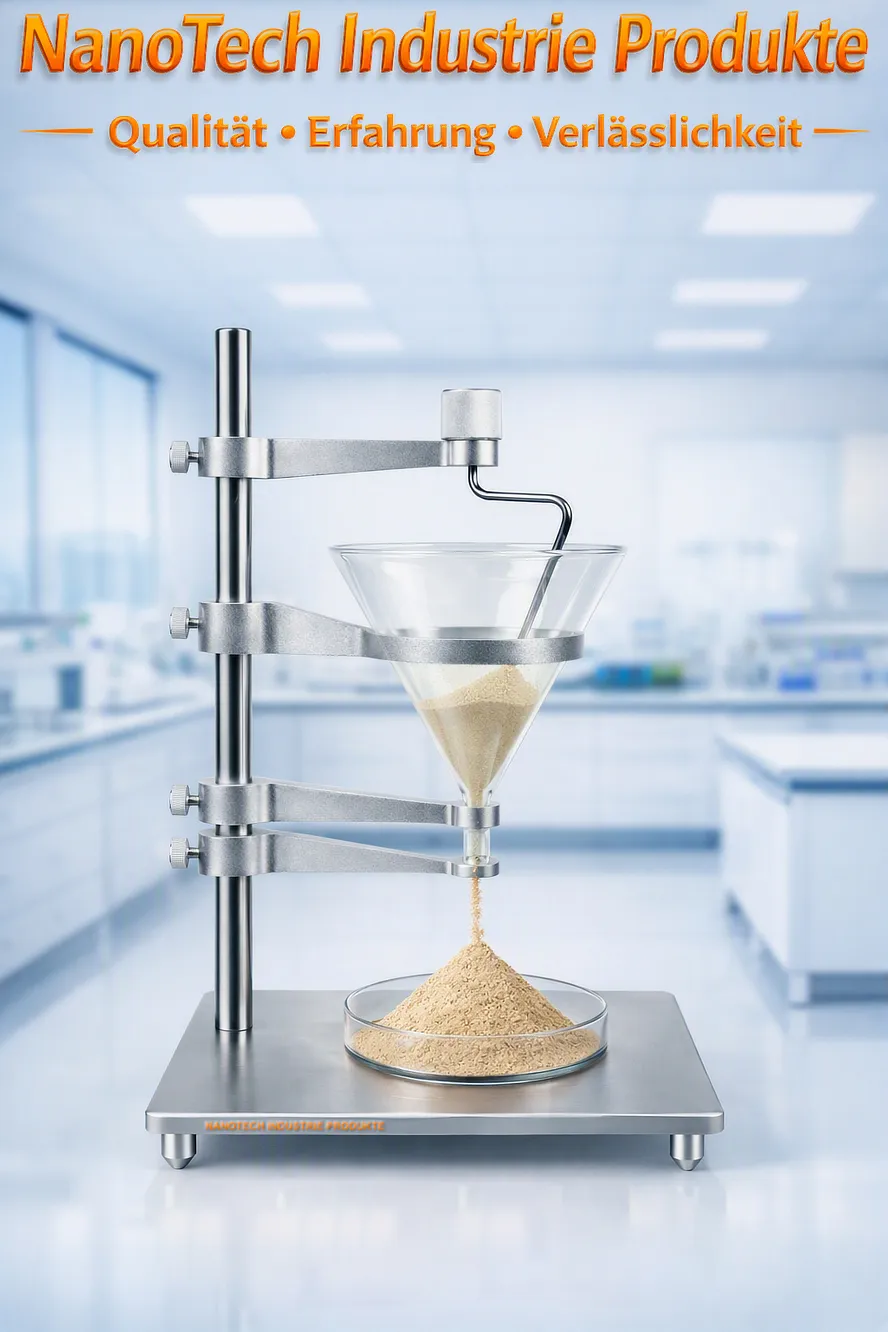
Präzisions‑Schüttwinkelprüfaufbau NIP‑PAR2800 - Professioneller Schüttwinkeltester mit Glastrichter - Anwendung:
The NIP‑PAR2800 Präzisions‑Schüttwinkelprüfaufbau dient zur exakten Bestimmung der Fließfähigkeit von Pulvern nach dem Fixtrichter‑Verfahren, wie es in ASTM‑ und ISO‑Praktiken zur Pulvercharakterisierung angewendet wird. Das Gerät nutzt einen Borosilikat‑Glastrichter, einen kalibrierten Höhenblock sowie eine präzise Grundplatte, um einen reproduzierbaren Pulverkonus zu erzeugen, aus dem der natürliche Schüttwinkel berechnet wird.
ASTM‑orientierte Prüfmethode (Fixtrichter‑Verfahren)
ASTM führt keinen einzelnen, exklusiven Schüttwinkel‑Standard, jedoch wird das Fixtrichter‑Verfahren in mehreren ASTM‑Richtlinien zur Pulverhandhabung verwendet (z. B. ASTM C1444, ASTM D6393, ASTM E11). Der NIP‑PAR2800 folgt dieser etablierten ASTM‑Praxis zur Bewertung der freien Fließfähigkeit von Pulvern.
Ablauf nach ASTM‑Praxis
-
Vorbereitung des Prüfaufbaus
-
The Glastrichter wird in definierter Höhe über der Edelstahl‑Grundplatte fixiert.
-
Der Trichter muss sauber, trocken und frei von Rückständen sein.
-
-
Konditionierung der Probe
-
Das Pulver wird gemäß ASTM‑Probenahmeempfehlungen gesiebt oder entagglomeriert.
-
Feuchtegehalt und Korngrößenverteilung müssen stabil sein.
-
-
Kontrollierter Pulverauslauf
-
Das Pulver fließt ohne Vibrationen oder mechanische Unterstützung durch den Trichter.
-
Auf der Grundplatte bildet sich ein natürlicher Pulverkonus.
-
-
Messung der Konusgeometrie
-
The Höhe (H) des Pulverhaufens wird mit dem integrierten Höhenmessgerät bestimmt.
-
The Durchmesser (D) des Konus wird an der breitesten Stelle gemessen.
-
-
Berechnung des Schüttwinkels Der Schüttwinkel ergibt sich aus der geometrischen Beziehung wie in der entsprechenden ASTM Prüfnorm angeführt.
-
Dokumentation
-
Winkel in Grad angeben.
-
Angaben zu Probenkonditionierung, Trichterhöhe und Umgebungsbedingungen ergänzen.
-
Technischer Zweck nach ASTM
Die ASTM‑Praxis dient zur Bewertung von:
-
Pulver‑Kohäsion
-
Fließverhalten bei Transport und Dosierung
-
Entleerungsverhalten in Trichtern und Silos
-
Eignung für Mischen, Tablettieren, Verpacken
Besonders relevant für Pharma‑Pulver, Lebensmittelzutaten, Pigmente, Metallpulver und Feinchemikalien.
ISO‑orientierte Prüfmethode (ISO‑Pulverfließverhalten)
ISO‑Normen wie ISO 4324, ISO 4490 and ISO 9276‑6 behandeln das Fließverhalten von Pulvern und freien Schüttgütern. Der NIP‑PAR2800 folgt dem ISO‑Fixtrichter‑Schüttwinkelverfahren, das in europäischen Laboren weit verbreitet ist.
Ablauf nach ISO‑Praxis
-
Gerätevorbereitung
-
The Glastrichter wird auf die ISO‑spezifizierte Höhe (typisch 50–75 mm) eingestellt.
-
Die Grundplatte muss exakt waagerecht und vibrationsfrei sein.
-
-
Einfüllen der Probe
-
Das Pulver wird ohne Verdichtung in den Trichter eingebracht.
-
Kein Klopfen oder Schütteln, um ISO‑Freiflussbedingungen einzuhalten.
-
-
Bildung des Pulverkonus
-
Das Pulver fließt durch den Trichter und bildet einen symmetrischen Konus.
-
Der Glastrichter ermöglicht eine klare Sicht auf das Fließverhalten.
-
-
Geometrische Messung
-
Höhe und Durchmesser des Konus werden mit ISO‑konformen Messgeräten bestimmt.
-
Wiederholungen sichern die Reproduzierbarkeit.
-
-
Winkelbestimmung ISO verwendet dieselbe geometrische Formel wie die entsprechende ASTM Prüfnorm.
-
Prüfbericht
-
Umgebungsbedingungen (Temperatur, Luftfeuchte) dokumentieren.
-
Fließanomalien wie Brückenbildung, Verklumpung oder ungleichmäßigen Auslauf vermerken.
-
Technischer Zweck nach ISO
Die ISO‑Methode wird bevorzugt, wenn:
-
Reinheit und Sichtkontrolle entscheidend sind
-
feine oder kohäsive Pulver untersucht werden
-
reproduzierbare Laborbedingungen gefordert sind
-
Pulver für hochwertige Anwendungen bewertet werden
Ideal for Pharma, Kosmetik, Lebensmittelpulver, Additive‑Manufacturing‑Pulver und Spezialchemikalien.
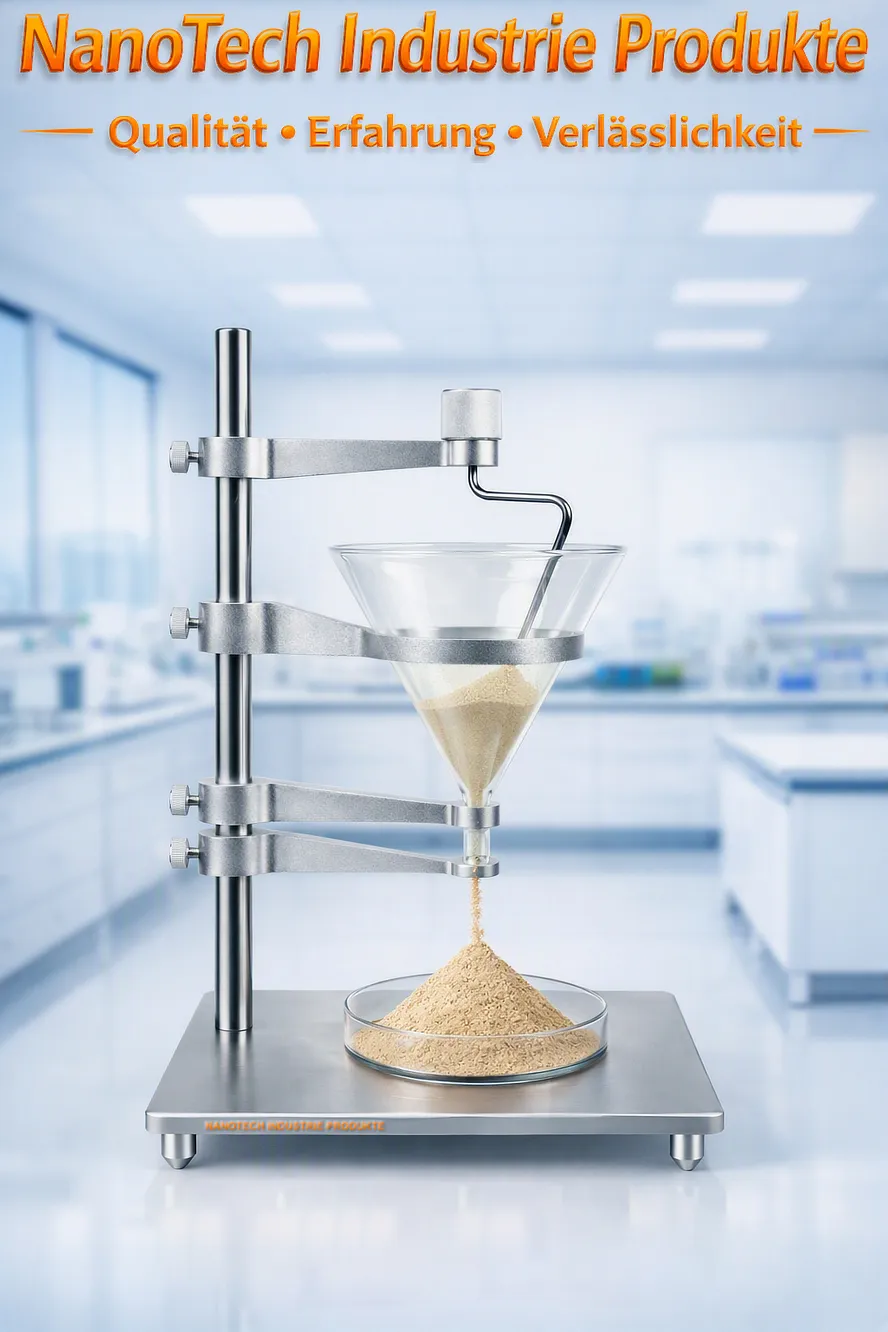
DIN EN ISO angle of repose apparatus with glass flow funnel – Special features:
- Professional Angle of Repose Determination
- Precision dropping funnel made of durable & high-quality laboratory glass
- Angle of repose tester made of high-quality materials
- Powder funnel angle 60°
- Flow funnel discharge opening of 10.0mm
- The trickle funnel is made of high-quality laboratory glass to ensure high precision.
- Sturdy & Ergonomic Design
- User-Friendly Operation
- Integrated horizontal spirit level
- Height-adjustable leveling feet
- High Precision & High Accuracy
- Versatile application based on international guidelines & testing standards
- Ergonomic Design & Reliable Quality
- Manufactured in accordance with internationally recognized guidelines and testing standards including ISO 4324, ISO 8398, DIN 12047, ASTM D6393-08, ASTM D6941, European Pharmacopoeia – EP 2.9.36/17, US Pharmacopoeia USP 1174
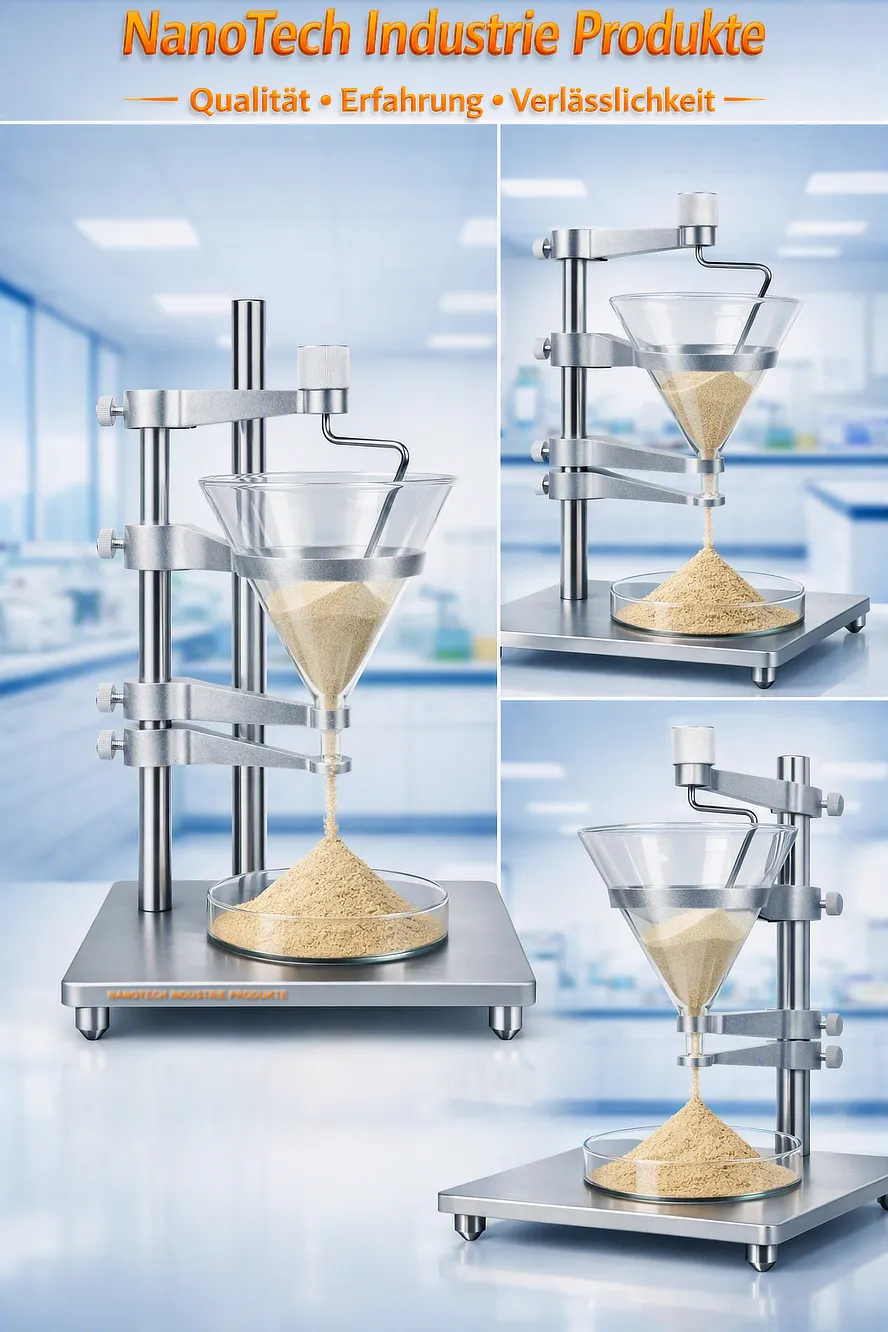
DIN ISO angle of repose test setup with glass funnel – Specifications:
| Model | NIP-PAR2800 |
|---|---|
| Precision-engineered angle of repose tester | Yes |
| Angle of the trickle funnel | 60° |
| outlet opening of the trickling funnel | Ø10.0mm |
| Diameter of the sample platform | Ø100.0mm |
| Reproducibility | ≤1% |
| Integrated horizontal directional drilling rig | Yes |
| Height-adjustable leveling feet | Yes |
| High Measurement Accuracy & High Precision | Yes |
| User-friendly angle of repose measurement | Yes |
| User-Friendly Sample Handling | Yes |
| Ergonomic Design | Yes |
| Reliable Quality | Yes |
| Manufactured in accordance with internationally recognized test standards including ISO 4324, ISO 8398, DIN EN 12047, ASTM D6393, ASTM D6941, USP 1174, EP 2.9.36/17 | |
ISO Angle of Repose Tester with Glass Flow Funnel – Scope of Delivery:
- DIN EN ISO angle of repose test setup with glass funnel
- Extensive Selection of Accessories
- Carefully and professionally calibrated
- Calibration Certificate
- Quality Certificate
- User Manual
- Advanced Technical Support
- Extended Warranty
Get more information about this product now. One of our experts will be happy to contact you with further helpful information.














 German
  English
  Dutch
Dutch  Dutch (Belgium)
  Danish
  Finnish
  French (France)
  French (Belgium)
  Irish
Irish  Luxembourgish
  Norwegian
  Norwegian
  Portuguese
  Scottish Gaelic
  Spanish
  Swedish
  Welsh
Welsh